
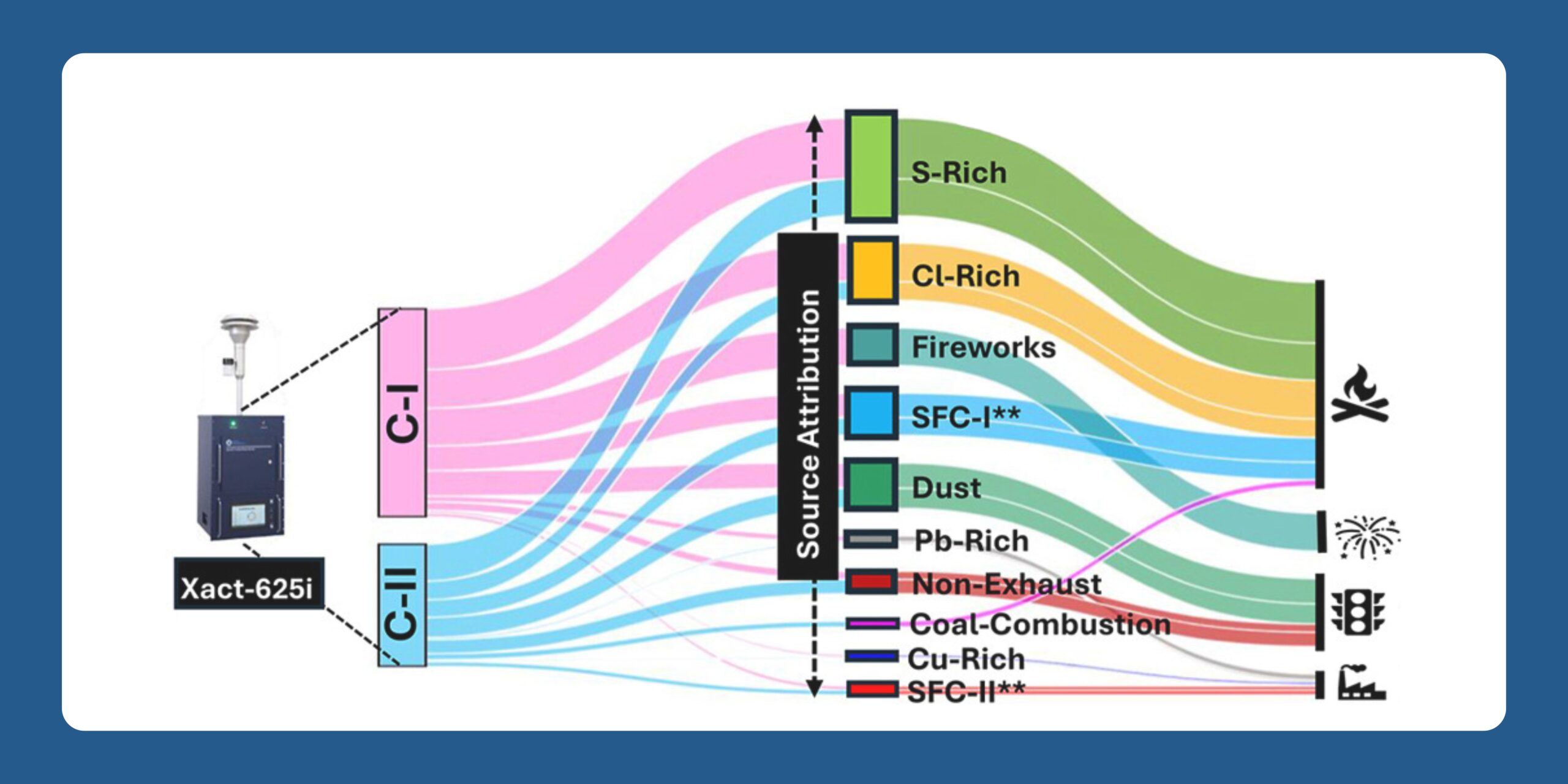
Particulate matter (PM) pollution remains one of the most pressing air quality challenges worldwide. To design effective control strategies, it is important to identify where the pollution is coming from and what sources are contributing to the majority of the PM pollution. This process, known as source apportionment, links measured pollution to contributing sources such as traffic, biomass burning, or industrial emissions.
Source apportionment provides multiple benefits. For policymakers, it supports more targeted emission reduction strategies, evaluation of the effectiveness of existing controls, and assessment of potential economic impacts. For health agencies, it clarifies which sources contribute the most toxic PM fractions and informs interventions for sensitive populations. Increasingly, regulators view source apportionment as essential; for example, the recent EU Directive 2024/2881 emphasizes source attribution in guiding ambient monitoring requirements.
High-time-resolution elemental monitoring has transformed source apportionment by enabling rapid dataset development, capturing diurnal patterns, identifying exceptional events, and directly correlating with meteorological conditions. This application note highlights selected peer-reviewed studies that demonstrate how Xact® data delivered unique benefits beyond conventional 24-hour methods.
The Importance of Metals in Source Apportionment
While organic and ionic species are valuable in source apportionment, many undergo chemical transformations in the atmosphere (e.g., SO₂ → SO₄²⁻). This makes it harder to link them back to their emission sources with confidence. In contrast, metals do not chemically transform during transport. Their elemental ratios therefore act as highly reliable “fingerprints” of sources. Table 1 shows a list of elements measured by Xact and their use in source apportionment.
By using these elemental tracers, researchers can separate sources with greater certainty than with filters or daily averages alone. This approach has been validated in numerous peer-reviewed studies worldwide.
The Importance of Highly Time Resolved Data
Traditionally, source apportionment relies on chemical speciation of 24-hour filter samples. These are labor-intensive to analyze and provide limited time resolution, often masking short-term source contributions. Advances in instrumentation over the last 10–15 years now allow for hourly or sub-hourly elemental measurements of PM, dramatically improving the ability to resolve sources. Instruments such as the Xact® 625i Ambient Metals Monitor have been widely adopted in peer-reviewed studies, demonstrating the value of high-time-resolution metals data in advancing both scientific research and policy decisions.
Table1: Elements measured by Xact and their use in source apportionment
| Element | Source |
|---|---|
| Al | Crustal |
| Si | Crustal, brakes, road dust |
| P | Sea salt, volcanic activity |
| S | Ship emissions, secondary aeorosol, coal combustion, fireworks |
| Cl | Sea salt, secondary aerosol, brick kiln, steel production, garbage burning, fireworks, road de-icer |
| K | Biomass burning, waste incineration, coal combustion, fireworks |
| Ca | Crustal, construction (gypsum), brakes, road dust |
| 2Ti | Crustal, fireworks |
| V | Dust, oil combustion (heavy fuel oil) |
| Cr | Traffic, waste incineration, oil combustion, brake wear |
| Mn | Traffic, waste incineration, oil combustion, plastic combustion |
| Fe | Crustal, steel production, brake wear |
| Co | Coal combustion |
| Ni | Traffic, waste incineration, oil combustion, ship emissions |
| Cu | Alloy manufacturing, brake wear, e-waste combustion, fireworks |
| Zn | E-waste burning, coal combustion, tire wear |
| Ga | Coal combustion |
| As | Coal Combustion, plastic combustion, waste incineration, battery recycling |
| Se | Coal Combustion |
| Br | Waste incineration, fuel additives, chemical manufacture |
| Rb | Crustal, waste incineration, coal combustion |
| Sr | Crustal, fireworks |
| Y | Rare earth mining, traffic, petroleum refining |
| Mo | Tungsten and copper mining, brake wear, catalytic convertors |
| Pd | Traffic (catalytic convertors) |
| Ag | Cloud seeding, coal combustion, cement manufacture |
| Cd | Alloy manufacturing, coal fly ash, e-waste combustion |
| In | Plastic combustion, e-waste burning, coal fly ash |
| Sn | Brake wear, plastic combustion |
| Sb | Brake wear, plastic combustion |
| Ba | Brake wear, fireworks |
| La | Rare earth mining, traffic, petroleum refining |
| Ce | Rare earth mining, traffic (catylic convertors), petroleum refining |
| Pt | Traffic (catalytic convertors) |
| Au | |
| Hg | Coal combustion, waste incineration |
| Tl | Smelting, cement plants |
| Pb | Battery recycling, e-waste combustion, brake wear |
| Bi | Fireworks |
1) More Quickly Develop a Statistically Robust Data Set
With hourly time resolution, a large enough data set can be generated to perform meaningful source apportionment calculations in as little as a month. Hourly data from Xact can produce 720 data points in 30 days. Standard filter sampling, on the other hand, would require nearly two years to generate a data set of equivalent size. This density accelerates the timeline for source apportionment modeling.
2) Identify More Sources than 24-Hour Data
High-time-resolution measurements allow receptor models to resolve sources that may otherwise appear blended in daily averages.
Wang et al. (2018) performed positive matrix factorization (PMF) to 30 days of hourly data from Shanghai, including Xact data, and compared it to artificially aggregated 4- and 6-hour datasets. They found the hourly data provided higher certainty and identified a greater number of sources.
3) Capture Diurnal Patterns
Diurnal or daily concentration patterns help pinpoint contributing sources. For example, traffic emissions peak during rush hours, while domestic biomass burning rises in the evening (Pragati, 2020).
Using hourly data measured with Xact and other instruments, Jeong et al. (2019) distinguished between traffic exhaust, brake wear, and resuspended road dust based on diurnal variability, with clear rush-hour peaks during weekdays but not weekends. Such patterns are obscured in 24-hour averages.
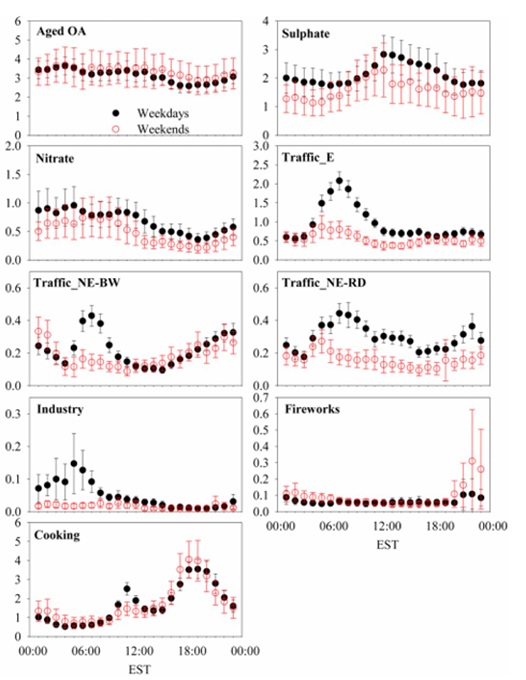
Jeong et al. (2019)
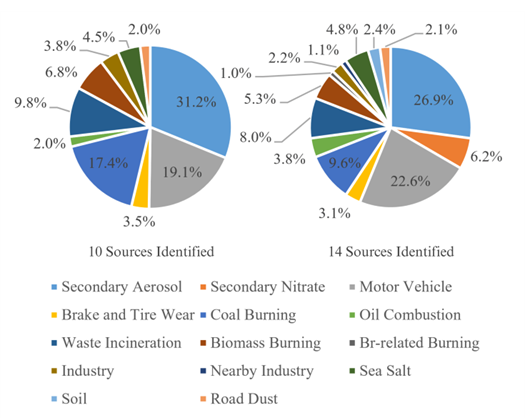
Park et al. (2019)
4) Correlate with Meteorological Conditions
Combining continuous metals data with meteorological variables such as wind direction, precipitation, or seasonality strengthens source attribution.
Park et al. (2019) showed that segmenting large PM2.5 datasets using meteorological data increased identifiable sources from 10 to 14.
5) Identify Exceptional Events
Short-lived episodes such as fireworks, wildfires, or industrial accidents are easily missed in daily samples but captured with high-time-resolution monitoring. Hasheminassab et al. (2020) used hourly metals data to characterize Fourth of July fireworks in Los Angeles, clearly separating episodic emissions from background sources.
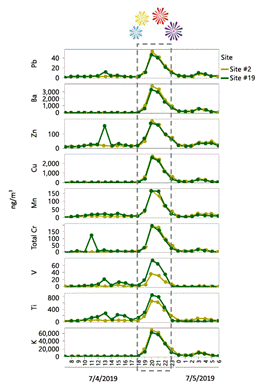
Hasheminassab et al. (2020)
Conclusion
High-time-resolution elemental monitoring has transformed source apportionment studies by providing large, statistically robust datasets in weeks rather than years. Compared to traditional 24-hour filters, hourly measurements can identify a greater number of sources, reveal diurnal patterns, link sources to meteorology, and capture short-lived exceptional events. Metals are particularly powerful in this context because elemental ratios serve as reliable tracers that do not undergo chemical transformation during transport.
The result is faster, more accurate source identification that benefits both researchers and policymakers. Researchers gain improved input to receptor models such as PMF, while policymakers receive stronger evidence to design targeted control strategies and document exceptional events. High-time-resolution metals monitoring is now a proven tool for advancing clean air policy and protecting public health.
Sources Used:
DIRECTIVE (EU) 2024/2881 OF THE EUROPEAN PARLIAMENT AND OF THE COUNCIL of 23 October 2024 on ambient air quality and cleaner air for Europe
Hasheminassab, S; Sowlat, M. H.; Pakbin, P.; Katzenstein, A.; Low, J.; Polidori. High Time-resolution and time-integrated measurements of particulate metals and elements in an environmental justice community within the Los Angeles Basin: Spatio-temporal trends and source apportionment. Atmospheric Environment X., 7, (2020)
Jeong, C., Wang, J., Hilker, N., Debosz, J., Sofowote, U., Su, Y., Noble, M., Healy, R., Munoz, T., Dabek-Zlotorzynska, E., Celo, V.,White, L., Audette, C., Herrod, D., Evans, G.; Temporal and spatial variability of traffic related PM2.5 sources: Comparison of exhaust and non-exhaust sources; Atomospheric Environment.; 198, (2019), 55-69
Park, M., Lee, T., Lee, E., Kim, D.; Enhancing source identification of hourly PM2.5 data in Seoul based on a data segmentation scheme by positive matrix factorization. Atmospheric Pollution Research 10, (2019) 1042-1059.
Pragati Rai, Markus Furger, Imad El Haddad, Varun Kumar, Liwei Wang, Atinderpal Singh, Kuldeep Dixit, Deepika Bhattu, Jean-Eudes Petit, Dilip Ganguly, Neeraj Rastogi, Urs Baltensperger, Sachchida Nand Tripathi, Jay G. Slowik, André S.H. Prévôt, Real-time measurement and source apportionment of elements in Delhi’s Atmosphere, Science of The Total Environment, 742, (2020).
Wang, Q., Qiao, L., Zhou, M., Zhu, S., Griffith, S., Zhen Yu, J.; Source apportionment of PM2.5 using hourly measurements of elemental tracers and major constituents in an Urban Environment: Investigation of time resolution difference; Journal of Geophysical Research: Atmospheres, (2018) 5284 – 5300
Banner Graphic Credit:
Akanksha Lakra, Ambasht Kumar, Davender Sethi, Himadri Sekhar Bhowmik, Vaishali Jain, Sachchida Nand Tripathi,
High-resolution source apportionment and health risks of PM2.5-bound trace elements across a major Indian city: Seasonal and diurnal insights from a multi-site campaign using a mobile laboratory platform, Atmospheric Environment, 365 (2020) 1352-2310 https://doi.org/10.1016/j.atmosenv.2025.121675
Comments are closed